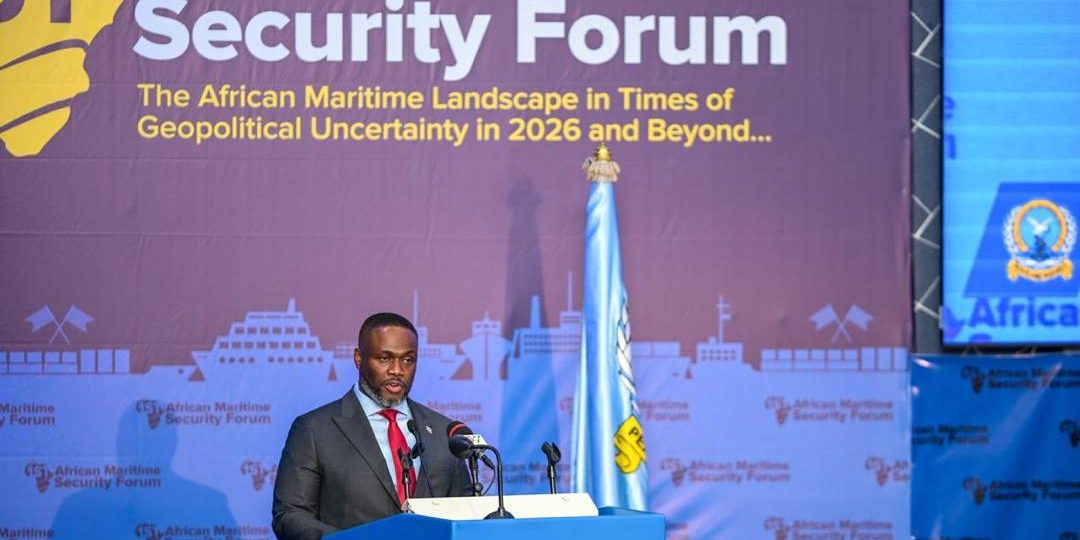
The Minister for Defence, Kenneth Gilbert Adjei, has warned that criminal networks operating in Africa’s maritime domain are increasingly exploiting cross-border connections between land, sea, and air, making it imperative for African nations to adopt coordinated, intelligence-led, and sustained security measures.
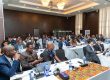
Speaking at the opening of the maiden 1st African Maritime Security Forum in Accra, on Wednesday, October 14, 2025, Mr Adjei emphasized that maritime security cannot be managed in isolation from developments on land, stressing that ocean boundaries must be preserved as secure corridors for legitimate trade and shared economic prosperity rather than transit routes for criminality. 
The two-day forum, organized by the Kofi Annan International Peacekeeping Training Centre (KAIPTC), the Security Institute for Governance and Leadership in Africa (SIGLA) at Stellenbosch University, and the Royal Danish Defence College (RDDC), the African Maritime Security Forum elevates a four-year collaborative initiative into a continental platform.
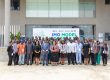
It brought together Chiefs of Naval Staff of Ghana, Nigeria, Kenya, Sierra Leone, Côte d’Ivoire and South Africa. Maritime regulators, administrators, as well as senior military officers, and industry stakeholders from Denmark, Togo, Madagascar, Cabo Verde, France, and the United States of America also attended the forum.
Unifying African Seas
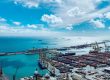
The forum was convened to highlight West, Southern, and East Africa as an interconnected maritime landscape persistently exposed to dynamic security threats, ranging from traditional piracy, armed robbery, and Illegal, Unreported, and Unregulated (IUU) fishing to the geopolitical spillover of global shipping disruptions and the misuse of autonomous technologies by illicit networks.
The forum also sought to include providing a cross-regional platform for high-level maritime stakeholders and scholars to share insights, fostering mutual comprehension of capacity-building strategies, promoting information fusion and international legal frameworks such as the San Remo Manual on the Law of Armed Conflict at Sea, and formulating concrete policy recommendations directed at national governments and regional economic bodies.
Policy to Action
The Minister highlighted that while Ghana relies on a robust framework of national legislation and international conventions to govern its territorial waters and ports, legal statutes achieve their full intent only through capable personnel, operational synergy, and practical enforcement.
“The maritime domain cannot be managed as though it were separate from developments on land or in the air,” Mr Adjei said. “Maritime safety and security are not the responsibility of navies alone; they depend on cooperation across government, industry, regional bodies, and international partners, the Minister added.
Commending the Government of Denmark for its long-standing strategic support to Ghana and the wider Gulf of Guinea region, Mr Adjei cited key Danish-funded initiatives, including the tactical maritime simulation center at Naval Training Command (NAVTRAC) at Nutakor in the Volta Region as well as containerized Ship-in-a-Box anti-piracy training facility, and tactical equipment provided to the Ghana Navy’s Special Boat Squadron and the Army Special Operations Brigade, as stellar examples of international partnerships that build enduring local capacity.
Sustainable Funding
The Danish Ambassador to Ghana, Jakob Linuf, underscored the evolving nature of global maritime commerce and security.
He observed that while regional cooperation has successfully reduced piracy incidents in the Gulf of Guinea maritime domain, the maritime security environment continues to evolve rapidly, requiring continuous adaptation, freedom of navigation safeguards, and sustained training across African defense forces. 
Denmark, he noted as a major global shipping and logistical nation, remains deeply invested in keeping international sea lanes safe for seafarers and commerce.
The Director of the Organ on Politics, Defence, and Security Affairs at the Southern African Development Community (SADC), Ismael Theletsane, called on African states and regional blocs to harmonize coordination efforts and prioritize sustainable, domestic funding for maritime security operations to ensure long-term resilience against emerging threats.
KAIPTC
The Commandant of the KAIPTC, Air Vice Marshal David Anetey Akrong, in his welcome remarks commended the strategic synergy between KAIPTC, Stellenbosch University, and the Royal Danish Defence College in elevating the annual conference into a continent-wide forum.
Air Vice Marshal Akrong reiterated KAIPTC’s commitment to providing research, executive training, and policy guidance aimed at strengthening maritime governance across Africa. He urged all participants to engage in open, intellectually rigorous deliberations over the two-day event to deliver practical, evidence-based recommendations that will directly inform national policies and enhance the safety of Africa’s blue economy.