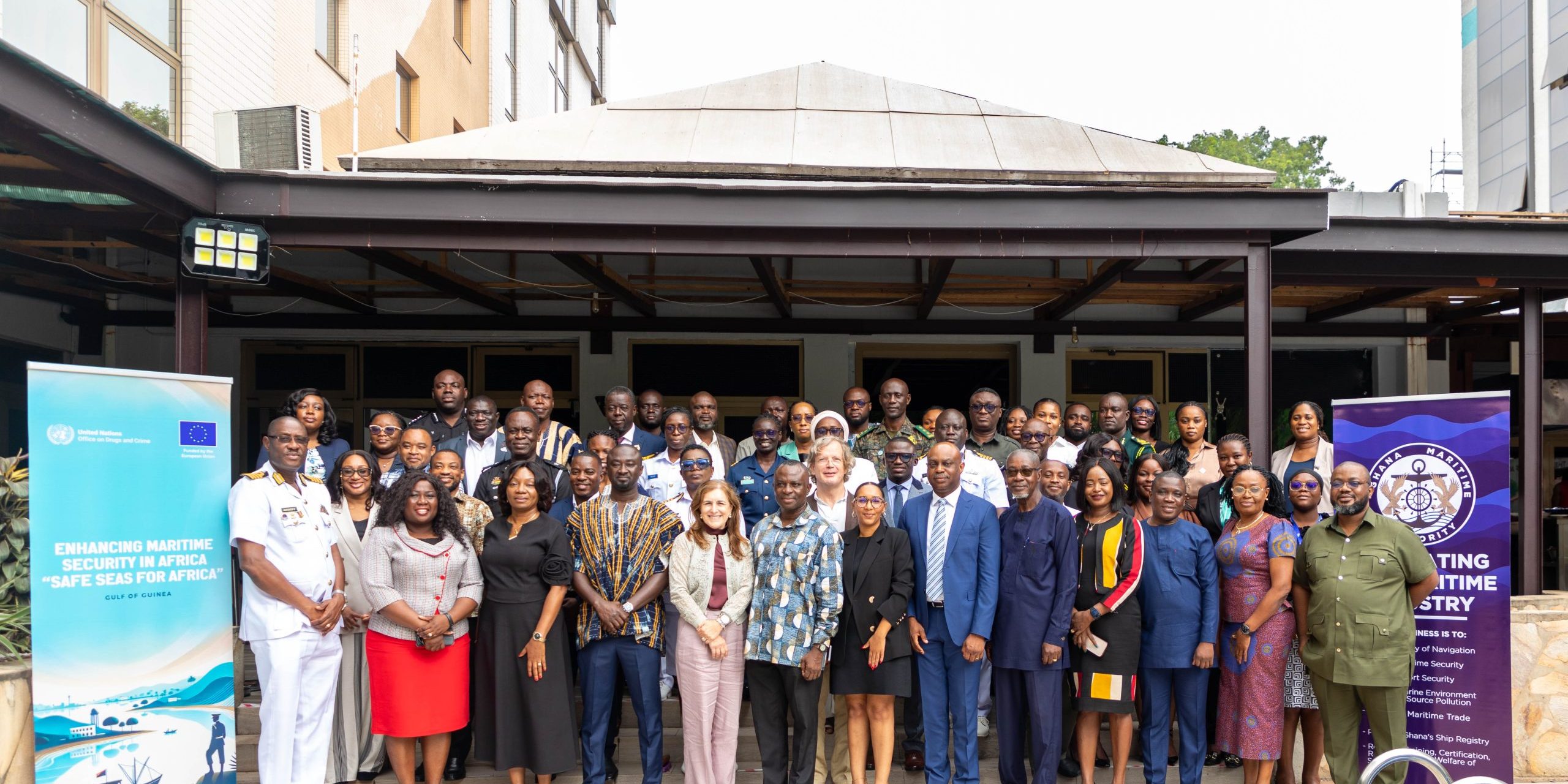
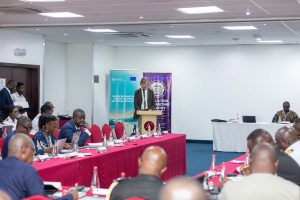
A two-day stakeholder sensitization workshop has been held in Accra, bringing together key security, judicial, and maritime authorities to map out the implementation strategy for Ghana’s new Maritime and Related Offences Law, 2026.
Organized under the theme “Enhancing Maritime Security in Africa: Safe Seas for Africa,” was spearheaded by the Ghana Maritime Authority (GMA) in collaboration with the United Nations Office on Drugs and Crime (UNODC) and the European Union (EU). 
The workshop formed part of the broader Safe Seas for Africa project, funded by the EU and executed alongside the UNODC to boost law enforcement capacity across the Gulf of Guinea in preventing, investigating, and prosecuting maritime offenses.
Representatives from the Ministry of Transport, Ghana Navy, Ghana Air Force, Marine Police, Attorney General’s Department, and the broader criminal justice system attended the workshop which was aimed to prepare operational frameworks ahead of the law’s full rollout.
The workshop saw participants establishing key priorities for joint enforcement, international cooperation, and judicial training to ensure Ghana’s territorial waters remain secure.
Ministry
Speaking on behalf of the Minister for Transport, Joseph Bukari Nikpe, the Chief Director of the Ministry, William Kartey, highlighted Ghana’s strategic ambitions for the sub-region. 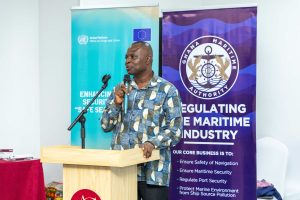
“The Ministry is taking decisive steps to position Ghana as a premier maritime hub in the sub-region,” Mr Kartey stated. “To achieve this, we must ensure our domestic legislation strictly aligns with international maritime law”, he added.
He commended the EU, UNODC, and the GMA for their leadership in convening the session.
GMA
Addressing delegates, the Deputy Director-General of the GMA, Mubarick Masawudu, underscored the urgency of updating the nation’s legal architecture.
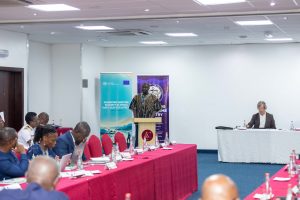 He noted that while the maritime sector served as a vital engine for Ghana’s economy, it faced increasingly complex threats, including piracy, armed robbery at sea, trafficking, and transnational organised crime.
“The Bill represents a significant milestone in Ghana’s efforts to strengthen its legal and institutional framework for combating maritime crime as it addresses current challenges by providing clarity, certainty, and modern legal tools for the suppression of crime at sea”, Mr Masawudu said.
The DDG emphasized that whereas the law moves into implementation, it was necessary t prepare enforcement officers and prosecutors early to ensure seamless execution.
International Alliance
The Programme Officer for the EU Governance Section of the European Union, Jean-Pierre Bardoul, described the legislation as a powerful new instrument for Ghana.
 He noted that the Bill aligned national statutes with key provisions of the United Nations Convention on the Law of the Sea (UNCLOS), giving domestic courts clearer jurisdiction and resolving past prosecutorial bottlenecks.
Representing the UNODC, Professor Martha Chantel Ribero commended Ghana’s legal reforms as commendable and a positive step in the right direction.
She reaffirmed the agency’s commitment to offering technical support to the country’s criminal justice sector. “On our part at the UNODC, we remain committed to further supporting the criminal justice sector of Ghana in strengthening the rule of law through improved legislation, with the overall aim of tackling maritime crime,” Professor Ribero stated.