Ghana Targets Zero Emissions and Shorter Turnaround Times at Tema and Takoradi Ports
The project, implemented under the International Maritime Organization’s (IMO) GreenVoyage2050 Programme, aligns with the Government of Ghana’s recent designation of the Tema Port as a strategic 24-hour economy hub.
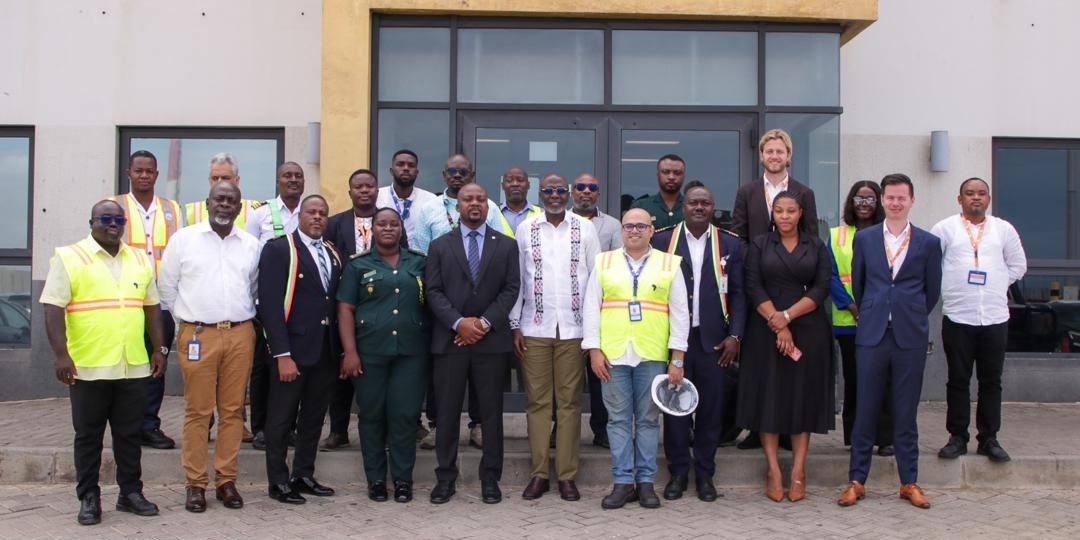
The workshop, organized by the IMO in partnership with the Ghana Maritime Authority (GMA), the Ghana Ports and Harbours Authority (GPHA), and the Meridian Ports Services Limited (MPS), brought together stakeholders from the Customs Division of the Ghana Revenue Authority (GRA), the Ghana Immigration Service, Port Health and representatives of shipping lines operating in Ghana, among others.
The JIT project seeks to identify the causes of idle time for vessels calling at MPS Terminal 3 and find ways to enhance port call optimization.
While the industry awaits the widespread availability of green fuels like hydrogen or ammonia, JIT serves as an immediate operational fix, dropping carbon footprints whilst enhancing port operational efficiency.
Driving a Green Transition
Opening the workshop, the Director General of the Ghana Maritime Authority, Dr Kamal-Deen Ali, emphasized that the global maritime industry is aggressively moving forward with a green transition, driven by the IMO’s ambitious 2023 Greenhouse Gas (GHG) Emissions Reduction Strategy to reach net-zero emissions by 2050. 
“Ports are important players in the maritime value chain,” Dr Ali noted, adding that the Just-In-Time initiative is intended to ensure port operations become highly efficient and effective, with the overall goal of reducing carbon footprints.
Ghana’s port infrastructure, the DG also highlighted, is becoming more robust by the day.
“If we are able to implement a Just-In-Time initiative, it means we are reducing costs while reducing emissions at the national level”, he said.
He expressed hope that the workshop would enhance the skill sets of stakeholders and be aggressively rolled out to line managers across organisations.
Dr Ali also stressed the national action plan’s focus on future-proofing operations by making renewables and green shore power available.
Immediate Emission Cuts
The IMO Regional Coordinator for West & Central Africa, Capt Dallas Laryea, pointed out that optimising port calls delivers instant, tangible rewards that do not have to wait for future technologies. 
Enhancing port call efficiency and reducing vessel waiting times, he said, could deliver immediate benefits, including lower fuel consumption, reduced emissions, improved schedule reliability, and increased port competitiveness.
Capt Laryea expressed optimism that sector players would successfully build a more efficient, resilient, and environmentally responsible port system.
Shorter Turnaround Times
The Harbour Master of the Tema Port, Capt Bramwell Tawiah, speaking on behalf of the Director of Port, Tebon Zumah, highlighted the stark reality of modern global shipping.
He observed that as the global economy expands, so do vessel emissions, demanding immediate and innovative operational overhauls.
“The Just-In-Time concept provides a practical framework to reduce vessel emissions while also improving port efficiency through shorter ship turnaround times,” Capt Tawiah stated.
The Chief Operating Officer of Meridian Port Services (MPS), Mahmoud Ayoub, injected a note of practical realism into the conversation, acknowledging that project implementation is historically challenging in Ghana.
He affirmed that MPS remains committed to achieving the ultimate goal and called for deep cross-industry collaboration, embracing both the project and the targeted development of local infrastructure and capacity.
Confronting the Complexity
The Consultant on the GreenVoyage2050 Project at the IMO, Rob Koggel, reminded participants that execution requires grit and open-mindedness.
Having facilitated similar rollouts worldwide, including a project in the port of Tanjung Pelepas in Malaysia two years ago, Mr Koggel noted that while the shared goal is identical, every single port possesses unique dynamics.
“Reduction of emissions in the short term may sound very easy, but in practice, it is complex,” he warned.
He challenged the local partners to think outside the box, urging everyone to remain entirely open to the conversations, emphasizing that, through targeted knowledge-sharing, rigorous training, and institutional synergy, the Tema Port will be well-positioned to lead West Africa’s charge into a sustainable, low-carbon maritime future.